
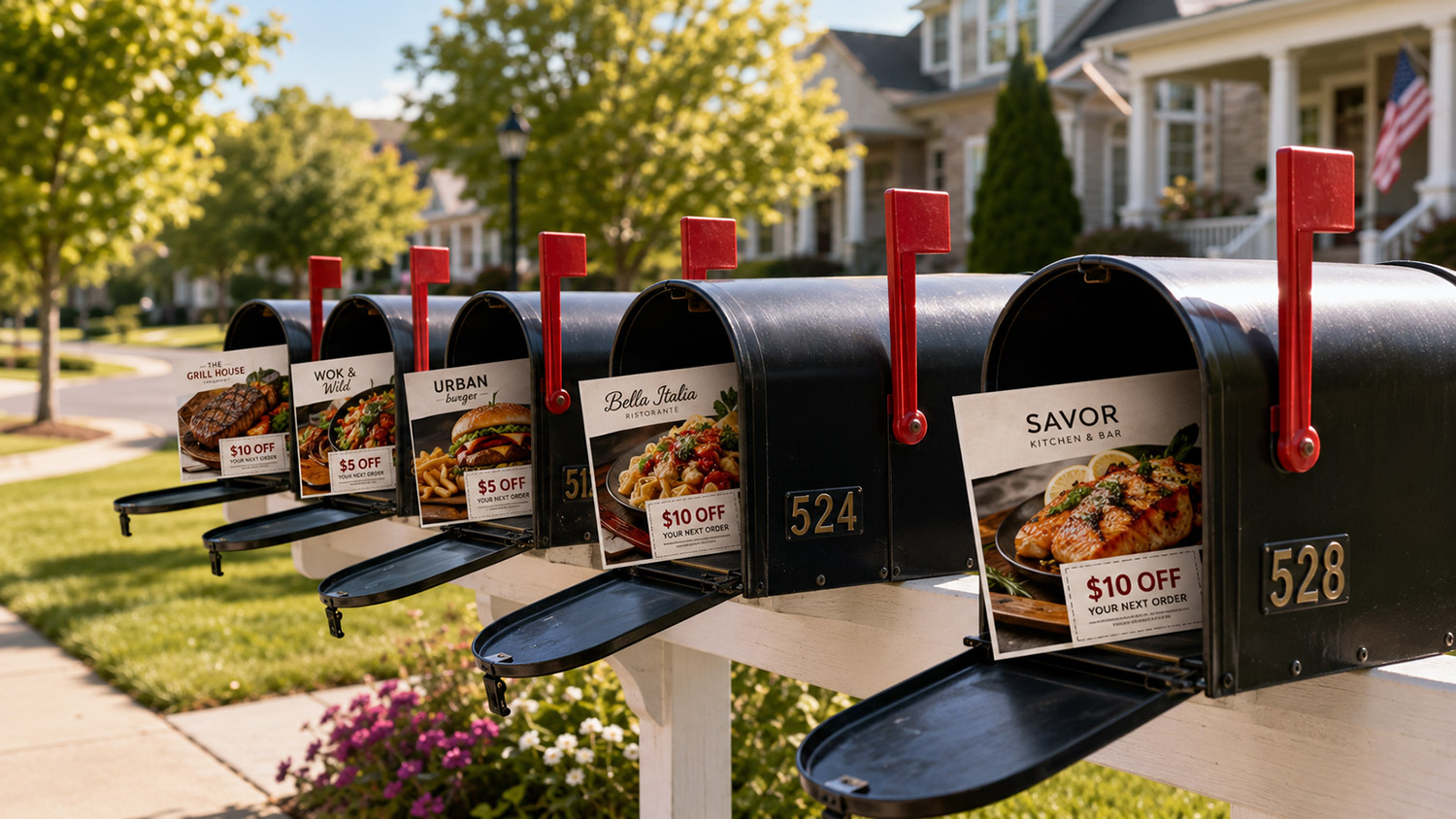
Restaurant owners have plenty of ways to promote their business. Digital ads, social media, email, loyalty programs, search marketing, and printed coupons can all play a role.
The hard part is not finding advertising options. It is choosing the ones that bring in profitable customers without weakening your brand or cutting too deeply into each order.
Direct mail remains one of the most useful tools in Restaurant Marketing because restaurants serve a local audience. Most customers live, work, or regularly travel within a few miles of the restaurant. Direct mail allows you to reach those households with a clear offer at the exact moment you want to increase traffic.
The format of the mailer matters, though.
A restaurant placed inside a shared coupon book may technically reach thousands of homes. That does not mean the restaurant will receive meaningful attention. Your offer is competing with pizza shops, oil-change coupons, carpet cleaners, dentists, salons, and dozens of unrelated businesses.
A stand-alone postcard creates a very different experience. Your restaurant owns the entire piece. Your food, offer, location, and brand are the only things the customer sees.
After years of managing local direct mail campaigns, we have found that focus usually wins.
Your Restaurant Should Not Have to Compete for Attention Inside Its Own Advertisement
A coupon book may contain 20, 30, or even 50 offers. When it reaches a home, the customer must open it, flip through the pages, find the restaurant category, notice your offer, and decide whether it is better than the other offers nearby.
Every one of those steps creates another opportunity to lose the customer.
With a stand-alone postcard, the recipient sees the restaurant immediately. There is no envelope to open and no booklet to search. A strong food image, recognizable logo, bold offer, and nearby location can communicate the message in seconds.
That immediate visibility is valuable.
Postcards have historically generated some of the strongest response rates among common direct mail formats. Industry research has reported postcard response rates of roughly 4.25% in some campaigns, though actual restaurant results depend heavily on the offer, mailing list, market, timing, and brand recognition.
A postcard also gives the restaurant enough room to present a complete reason to visit. The front can create appetite appeal. The back can explain the offer, list the address, provide ordering instructions, and include a QR code.
A small coupon inside a crowded book rarely has enough space to do all of that well.
Stand-Alone Postcards Make the Food the Hero
Restaurant advertising has one advantage many other industries do not have: the product can create an emotional response almost instantly.
A close-up image of a sizzling burger, colorful street tacos, fresh pasta, or a family-sized barbecue platter can make someone hungry before they finish checking the mail.
Coupon books often restrict image size. Some rely heavily on small logos, thin columns, or tightly packed offers. Even when food photography is allowed, the image may be too small to make much of an impression.
A stand-alone postcard gives the creative room to breathe.
For a casual Italian restaurant, we might use the front of an oversized postcard to feature a large image of a signature pasta dish. The offer could read, “Enjoy $10 Off Your Next Dinner of $40 or More.” The restaurant name, neighborhood, and expiration date would remain easy to find without covering the food.
For a quick-service restaurant, the front may work better with a specific combo meal and a simple price-based offer. A postcard promoting “Two Lunch Combos for $19.99” gives the customer something concrete to understand.
The goal is not to cram the entire menu onto the card. The goal is to create one clear, appealing reason to visit.
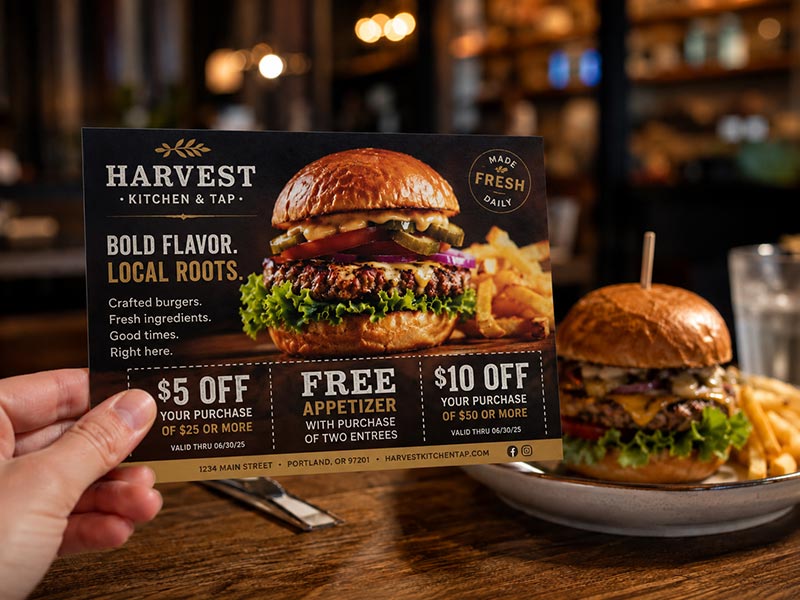
A Focused Mailer Gives You More Control Over the Offer
One of the biggest weaknesses of many restaurant coupon mailers is that they encourage businesses to compete mainly on discount size.
When customers see several restaurants next to each other, the offer with the largest percentage off may appear to be the best choice. That can push owners toward deep discounts that increase traffic but produce weak margins.
A successful promotion should attract customers without giving away more food than necessary.
For example, “20% Off Your Entire Order” may seem attractive, but it reduces revenue across every item purchased. A more controlled offer, such as “$10 Off an Order of $50 or More,” protects a minimum ticket amount.
Other practical offers may include:
- A complimentary appetizer with the purchase of two entrées
- A free kids’ meal with an adult entrée
- $5 off a takeout order of $30 or more
- A free dessert for first-time guests
- A weekday lunch special available Monday through Thursday
The best offer depends on the restaurant’s average ticket, food cost, slow periods, table capacity, and customer habits.
At TurnHeads Marketing, we do not look at the discount by itself. We consider what happens operationally when the promotion is redeemed.
Can the kitchen handle a heavy Friday-night response? Does the restaurant need more weekday traffic instead? Will the offer increase average order value? Is it designed to introduce new customers or reactivate previous guests?
A well-planned Restaurant Direct Mail Service should help answer those questions before the postcards are printed.
Stand-Alone Postcards Build Brand Recognition
A coupon book often generates what we call “deal recognition” rather than brand recognition.
The customer remembers that they saw a discount. They may not remember which restaurant offered it.
A stand-alone postcard has more room for the visual elements that make the restaurant recognizable. That includes the logo, brand colors, food style, storefront, atmosphere, and overall personality.
This matters even when the recipient does not redeem the coupon immediately.
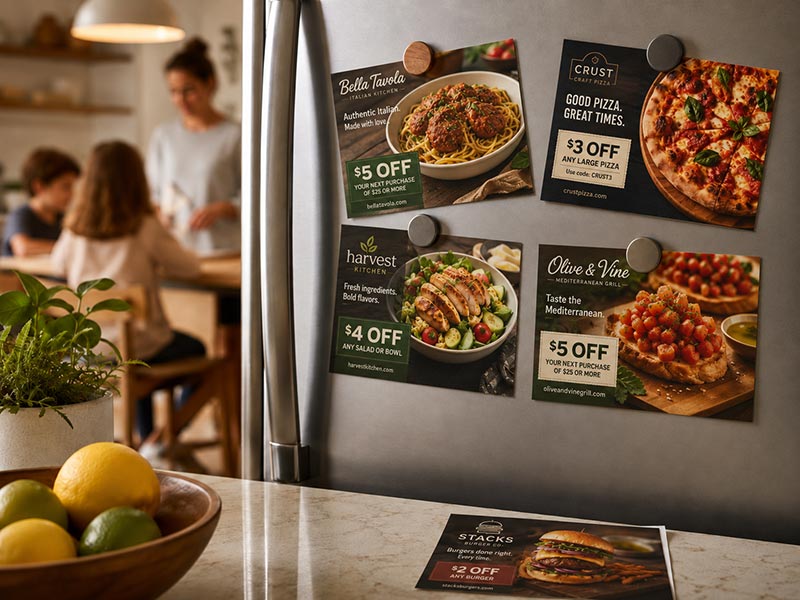
A homeowner may place the postcard on the refrigerator. Someone else in the household may see it later. The family may remember the restaurant when they need a quick dinner the following week.
Some direct mail research has found that printed pieces can stay inside a household for weeks after delivery, extending exposure beyond the first mailbox interaction.
That longer shelf life is especially useful for restaurants because dining decisions are often spontaneous. The postcard may arrive on Tuesday, but the visit may happen on Saturday.
A well-designed mailer can keep working after the initial offer has been noticed.
Better Targeting Produces Better Restaurant Traffic
Direct mail performance is heavily influenced by geography.
For most restaurants, mailing farther does not automatically mean reaching more valuable customers. It may only mean spending money to reach households that are unlikely to make the drive.
A neighborhood pizza shop may perform well within a three-mile radius. A destination steakhouse or entertainment-based restaurant may attract customers from a wider area. A lunch-focused restaurant may need to target nearby businesses rather than residential neighborhoods.
Research involving restaurant coupon distribution has also shown that proximity can affect redemption and that distance does not influence every market in the same way.
This matches what we see in practical local campaigns.
Before building a mailing area, we consider:
- The restaurant’s location and access points
- Drive times rather than radius alone
- Nearby neighborhoods and subdivisions
- Household income and family composition
- Competitors within the trade area
- Delivery and takeout boundaries
- Major roads that help or prevent customer travel
- Customer addresses already found in the restaurant’s database
A stand-alone postcard campaign can be mapped around the restaurant’s actual service area. A broad coupon publication may distribute to a larger predetermined zone, whether or not every household is a realistic customer.
More circulation is not always better. Relevant circulation is better.
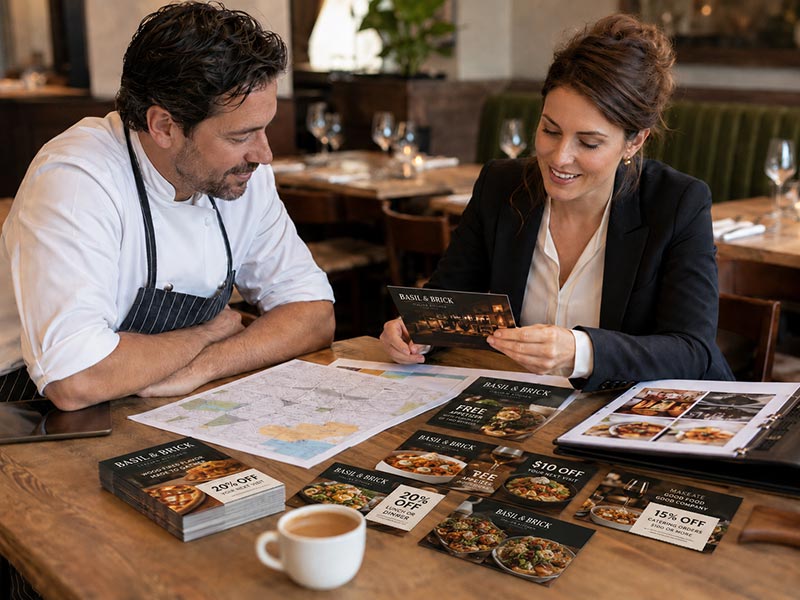
Timing Can Be Built Around the Restaurant’s Needs
Restaurants do not need the same promotion every month.
A family restaurant may want to increase visits before school starts. A sports bar may promote football season. A catering restaurant may need holiday bookings. A new location may want heavy exposure during its first eight weeks.
Coupon books usually follow the publisher’s schedule. The restaurant purchases placement in a predetermined issue and waits for the book to arrive.
Stand-alone mail gives the restaurant much more control.
A campaign can be scheduled around:
- A grand opening
- A new menu launch
- A seasonal patio opening
- A slow month
- A holiday catering deadline
- A loyalty program launch
- A limited-time menu item
- A new delivery area
- A remodeled dining room
- A competitor closing nearby
Mail delivery can also be staggered.
Instead of dropping 20,000 postcards into the market at once, a restaurant may mail 5,000 per week for four weeks. That approach can reduce operational strain and give the team time to monitor redemptions.
It is frustrating to launch a strong promotion only to have the staff overwhelmed, the kitchen fall behind, and first-time guests leave with a poor impression. Marketing and operations have to support each other.
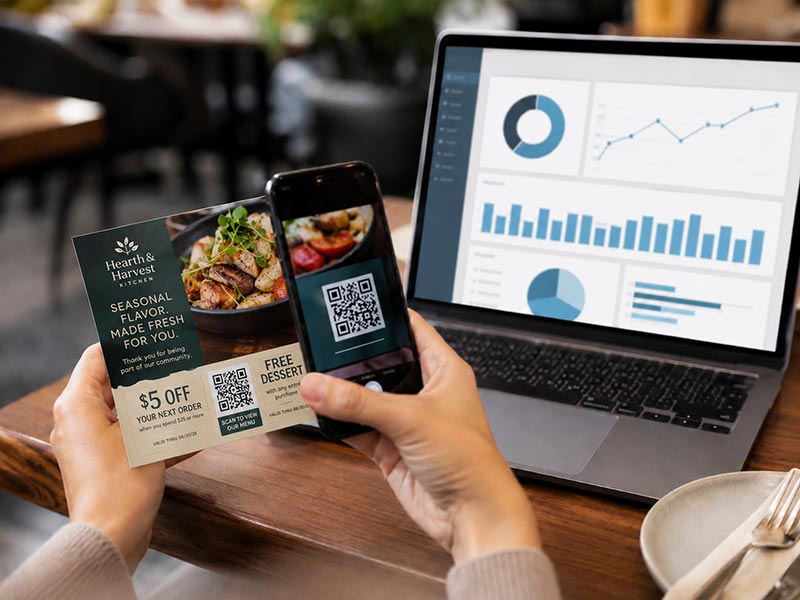
Stand-Alone Campaigns Are Easier to Track
Restaurant owners should be able to tell whether a promotion produced revenue, not just whether customers mentioned seeing it.
A stand-alone postcard can include several tracking methods:
- A unique coupon code
- A scannable QR code
- A dedicated landing page
- A trackable phone number
- A point-of-sale promotion button
- A unique online ordering code
- A required physical coupon
- Separate codes for different mailing areas
Suppose a restaurant mails 10,000 postcards to two nearby ZIP codes. Each ZIP code can receive a different offer code.
At the end of the campaign, the restaurant may discover that one area produced 140 redemptions while the other produced 55. The next campaign can place more weight on the stronger neighborhood.
The restaurant should also record more than the number of coupons collected. Useful campaign data includes total sales, average ticket, food cost, first-time guests, online orders, repeat visits, and redemption by day of the week.
A promotion that generates 100 redemptions with an average ticket of $52 may be much healthier than one generating 160 redemptions with an average ticket of $24.
Redemption is only one part of the story.
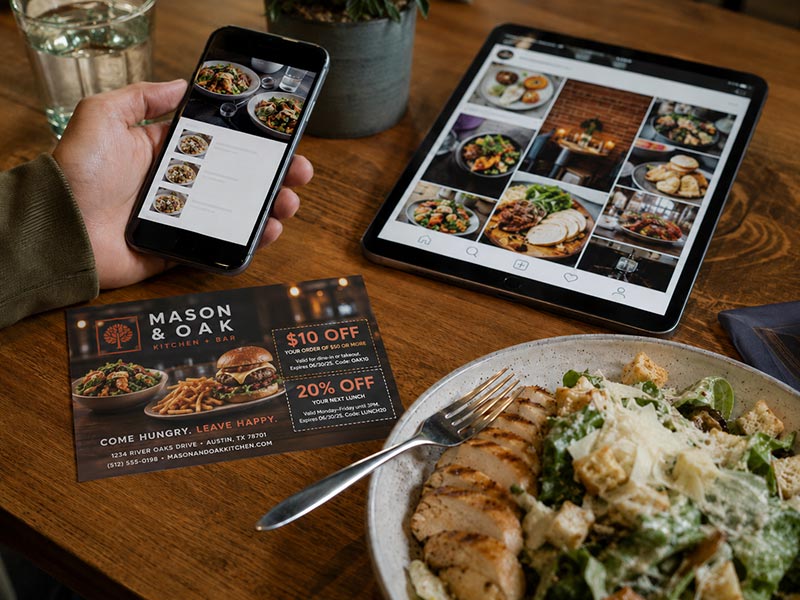
Direct Mail Works Better When It Supports Restaurant Digital Marketing
Stand-alone postcards do not have to compete with digital advertising. The strongest campaigns often let print and digital channels support each other.
Restaurant direct mail can introduce the offer. Restaurant digital marketing can reinforce it through social media, search ads, display advertising, email, and retargeting.
A customer may see the postcard at home, search for the restaurant on Google, read the menu, check the reviews, and place an online order. The final action appears digital, but the postcard may have created the initial interest.
Restaurant industry research has reported that 53% of consumers said direct mail influenced them to visit a restaurant or order delivery or carryout. The same research reported average direct mail response rates of approximately 8% to 12% for some quick-service restaurant campaigns. Those numbers should be viewed as campaign-specific benchmarks rather than guaranteed outcomes.
A practical campaign may use a QR code that leads to a dedicated mobile page. That page can show the offer, menu, directions, ordering button, and redemption terms.
The restaurant can then measure QR scans, page visits, online orders, and completed redemptions.
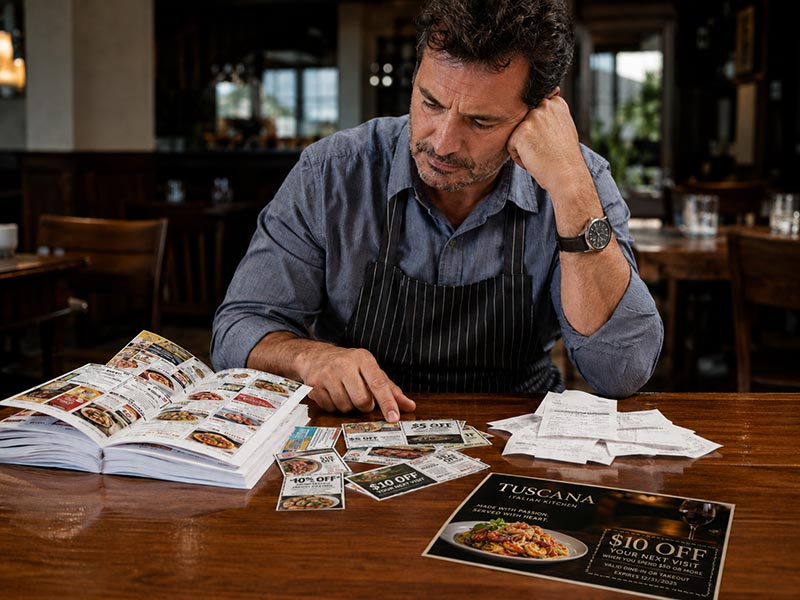
Why Cheap Coupon Book Placement Can Become Expensive
Coupon books often appear less expensive because the production and postage costs are shared among many advertisers.
The lower price can be attractive. Cost alone does not determine value.
A $600 coupon book placement that generates 12 low-margin redemptions may cost more per customer than a $3,000 stand-alone campaign that generates 150 trackable visits and builds stronger local awareness.
The restaurant owner should compare:
- Cost per mailed household
- Cost per redemption
- Cost per new customer
- Average ticket from promoted visits
- Gross profit after discounts
- Repeat visits from new customers
- Brand exposure within the target area
A shared mailer may still make sense as a small test or as one part of a wider campaign. The problem comes when it becomes the restaurant’s main direct mail strategy without proper tracking.
Visibility matters more than simply being included.
What a Strong Restaurant Postcard Campaign Looks Like
A reliable campaign begins with a clear objective.
“Get more customers” is too broad. A useful goal may be to increase Tuesday-through-Thursday dinner traffic, introduce the restaurant to new homeowners, build online ordering volume, or bring back guests who have not visited in six months.
From there, we develop the campaign around six working parts:
- Define the goal and target customer.
- Map a practical mailing area.
- Create an offer that protects the restaurant’s margins.
- Design the postcard around one primary message.
- Set up tracking before the mail enters production.
- Review results and adjust the next mailing.
We also inspect the small operational details that can affect performance.
Is the expiration date easy to read? Can the point-of-sale system accept the code? Does every manager understand the terms? Does the QR code work on both Android and Apple devices? Is the advertised item available throughout the campaign? Does the online ordering platform recognize the discount?
These details are not exciting, but they prevent avoidable problems.
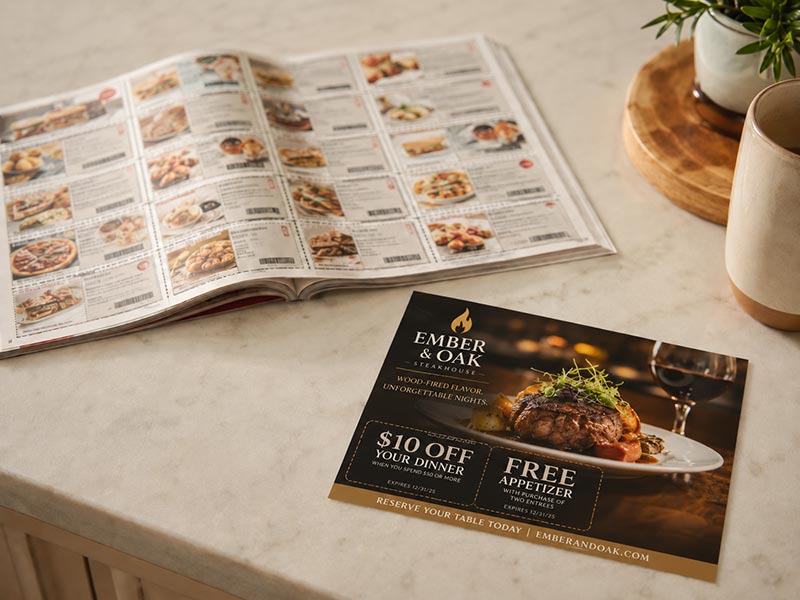
Give Your Restaurant the Entire Mailbox Moment
Coupon books give restaurants a small piece of a shared advertising product. Stand-alone postcards give restaurants their own message, their own timing, and their own space.
That difference can improve visibility, brand recall, offer control, geographic targeting, and campaign tracking.
At TurnHeads Marketing, we build local campaigns around how restaurants actually operate. We help restaurant owners choose the right mailing area, develop offers that make financial sense, create appetite-driven artwork, coordinate production, and connect direct mail with digital marketing.
Strong Restaurant marketing is not about sending the most coupons. It is about reaching the right households with a message they notice, understand, and act on.
A stand-alone postcard gives your restaurant a better chance to do exactly that.
Frequently Asked Questions
Oversized postcards such as 6-by-11-inch or similar formats provide enough room for strong food photography, a clear offer, and ordering information without making the layout feel crowded.
Yes. Property managers can provide recurring repair, maintenance, and replacement work, but they usually need fast communication, dependable documentation, and clear approval procedures.
Many restaurants benefit from several coordinated mailings rather than one isolated campaign. Frequency should reflect the restaurant’s budget, sales cycle, seasonality, and ability to track repeat exposure.
Yes. Customer lists can be useful for reactivation campaigns, birthday promotions, loyalty offers, and announcements, provided the restaurant handles customer data responsibly and follows applicable privacy requirements.
Specific prices can make an offer easier to understand, but only include them when the restaurant expects those prices to remain valid throughout the mailing and redemption period.
Yes. Location-specific codes and offers make it easier to address local competition, traffic patterns, menu differences, and performance goals.
A redemption window of roughly three to six weeks often creates urgency while giving households enough time to plan a visit. The best period depends on mailing frequency and restaurant type.
Requiring the card makes redemptions easier to verify, while a printed code or digital version offers more convenience. Restaurants can also accept both and track them separately.
Yes. Catering postcards can target nearby offices, schools, churches, medical practices, event planners, and higher-income households with holiday or event-specific messages.
Staff should know the offer terms, valid dates, coupon code, exclusions, redemption process, and how to handle customer questions. Managers should also know where campaign results will be recorded.