

Running an HVAC company means managing two businesses at the same time.
The first is the technical side. Your team installs systems, diagnoses equipment failures, responds to emergency calls, performs seasonal maintenance, and keeps customers comfortable.
The second is the marketing side. You need to keep the phone ringing, maintain a steady installation pipeline, retain existing customers, and make sure people can find your company when their air conditioner stops working on the hottest day of the year.
That second side often receives less attention.
Most HVAC owners did not start their businesses because they wanted to manage Google Ads, build mailing lists, write website content, or track conversion rates. They started because they knew the trade and saw an opportunity to provide better service.
The problem is that technical skill alone does not guarantee steady growth. A company can have excellent technicians, fair pricing, and dependable service while still losing calls to competitors with stronger visibility.
Effective HVAC Local Marketing closes that gap.
It helps your company stay visible before a homeowner needs service, show up when demand spikes, and build enough trust that the customer feels comfortable making the call.
This guide explains how to create a balanced HVAC marketing system using direct mail, digital advertising, local search, customer retention, seasonal promotions, and better lead tracking.
Why HVAC Marketing Requires a Different Approach
HVAC services are not purchased like clothing, restaurant meals, or household decorations.
Most homeowners are not browsing furnace replacements for entertainment. They begin searching because something happened.
- Their air conditioner is blowing warm air.
- The upstairs bedrooms will not cool down.
- The furnace is making a grinding noise.
- The utility bill suddenly increased.
- The thermostat is blank.
- A system that has been repaired several times has finally stopped working.
This creates a short, urgent buying window. When a customer needs help, the HVAC companies that are easiest to find and quickest to respond have a major advantage.
There is also a second side to the market. Not every HVAC purchase is an emergency. Maintenance agreements, indoor air quality upgrades, ductwork improvements, smart thermostats, and planned system replacements may involve weeks or months of consideration.
A strong HVAC marketing strategy must support both situations.
You need immediate-response marketing for urgent repair calls. You also need long-term visibility that helps customers remember your name before the emergency happens.
Start With the Economics of Your HVAC Business
Before choosing marketing channels, understand what a new customer is worth.
This sounds obvious, but many HVAC companies measure marketing only by the number of leads generated. That can lead to poor decisions.
Twenty low-quality price-shopping calls may be less valuable than five qualified replacement opportunities.
Look at the average value of each major service category:
- Diagnostic and repair calls
- Seasonal tune-ups
- Maintenance agreements
- Indoor air quality services
- Duct cleaning or duct repair
- Heat pump replacements
- Air conditioning replacements
- Furnace installations
- Light commercial service
- Full system replacements
You should also estimate the long-term value of a customer.
A homeowner who schedules a $79 tune-up may later purchase a maintenance plan, call for repairs, refer a neighbor, and replace a system several years later. The initial ticket does not tell the full story.
We often see HVAC companies undervalue maintenance customers because the first transaction is small. In reality, maintenance programs can become one of the strongest sources of stable revenue and future replacement opportunities.
Your marketing budget should reflect customer lifetime value, not just the value of the first service call.
Define the Territory You Can Serve Well
More coverage is not always better.
An HVAC contractor may technically serve a 50-mile radius, but that does not mean every area within that radius is equally profitable.
Long drive times reduce technician productivity. Traffic delays make appointment windows harder to maintain. Distant calls can create scheduling problems during peak season.
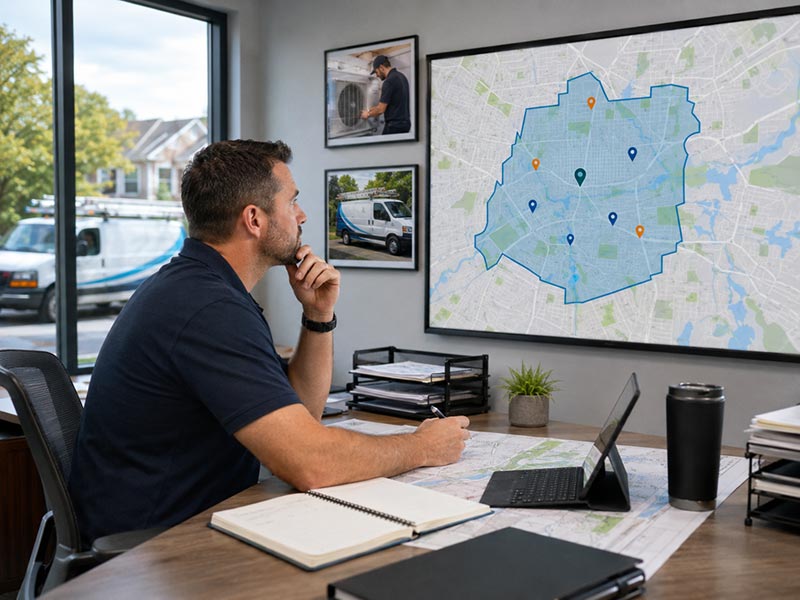
Start by dividing your market into practical service zones.
Your primary zone should include cities and neighborhoods where you already have strong customer density, efficient drive times, and reliable coverage.
Your secondary zone may include areas you want to grow but where you currently have fewer customers.
Your outer zone may only be practical for large replacement jobs or scheduled installations.
This geographic planning should guide every part of your HVAC marketing. It affects direct mail routes, Google Ads targeting, website location pages, technician scheduling, and promotional offers.
A company that serves northern suburbs, for example, should not spend heavily advertising in downtown neighborhoods that regularly require a 75-minute drive.
Good marketing brings in more calls. Smart marketing brings in calls that fit your operation.
Build a Clear Message Before You Buy Advertising
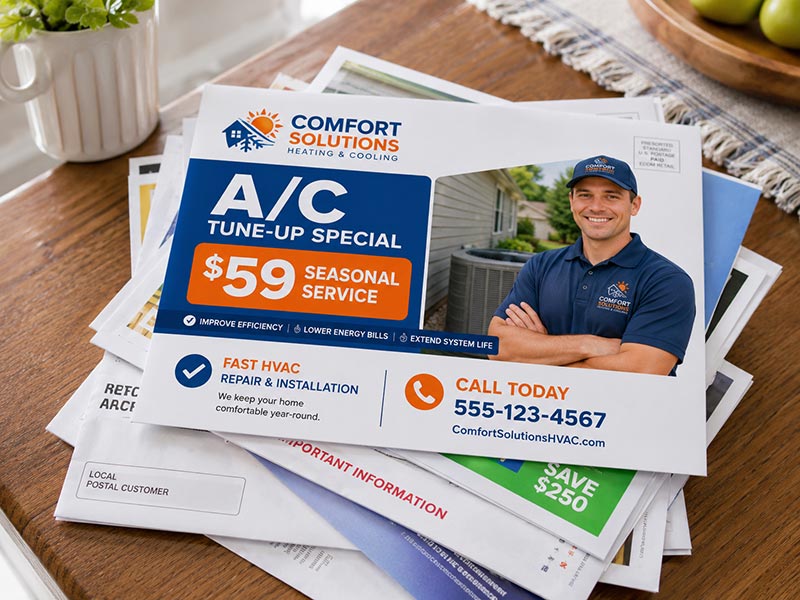
Many HVAC advertisements say almost the same thing:
- “Quality service.”
- “Honest pricing.”
- “Your comfort is our priority.”
- “Call today.”
None of those statements are harmful, but they do little to separate one company from another.
Your marketing should answer a more practical question:
Why should a homeowner call you instead of the other six HVAC companies they found online?
The answer may involve:
- Same-day appointments
- Extended service hours
- No overtime charges
- Upfront pricing
- Background-checked technicians
- Financing options
- Strong manufacturer certifications
- Maintenance plan benefits
- Long-standing local ownership
- Special experience with heat pumps
- Commercial refrigeration capabilities
- A strong labor warranty
- A clear replacement consultation process
Choose advantages that you can consistently deliver.
Do not advertise same-day service if your schedule is usually full for three days. Do not promise 24-hour availability if calls go to voicemail after 6:00 p.m.
Strong marketing creates expectations. Your operation must be able to meet them.
Create a Seasonal HVAC Marketing Calendar
HVAC demand is highly seasonal, but marketing should not begin after the weather changes.
By the time the first major heat wave arrives, homeowners are already searching, competitors have increased their ad budgets, and service schedules are filling quickly.
A better approach is to plan campaigns six to eight weeks ahead.
Early Spring
Focus on air conditioning tune-ups, maintenance agreements, system inspections, duct concerns, and early replacement planning.
This is the time to fill the schedule before emergency calls take over.
Late Spring and Summer
Shift toward cooling repairs, same-day service, replacement financing, indoor comfort problems, and high utility bills.
Your messaging should become more urgent and direct.
Early Fall
Promote heating inspections, furnace tune-ups, heat pump maintenance, indoor air quality, and system safety checks.
This is also a useful time to reconnect with customers who postponed spring service.
Winter
Focus on heating repairs, furnace replacements, no-heat calls, carbon monoxide concerns, and maintenance plan enrollment.
In mild climates, winter may also be a strong time to promote heat pumps and energy-efficient system upgrades.
Shoulder Seasons
Slower periods are ideal for ductwork promotions, indoor air quality campaigns, dryer vent cleaning, insulation services, commercial maintenance, and customer reactivation.
The goal is not to eliminate seasonality. That is rarely realistic. The goal is to reduce extreme swings and create more predictable lead flow.
Use Direct Mail to Reach the Right Households
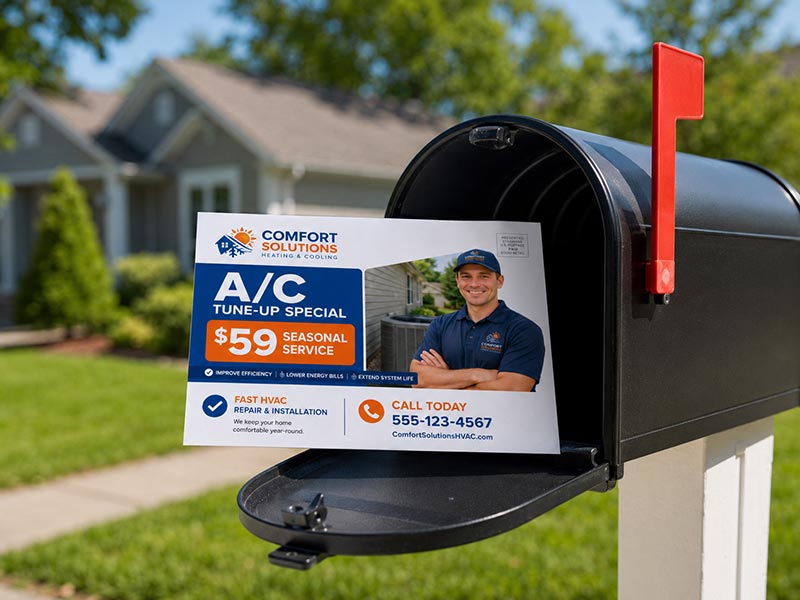
A well-planned HVAC Direct Mail Service can reach homeowners in specific neighborhoods before they begin actively searching online.
Direct mail works especially well for HVAC because service needs are closely tied to homeownership, property age, system age, neighborhood construction patterns, and seasonal weather.
A postcard does not have to wait for the homeowner to type a search into Google. It can introduce your company days or weeks before the need becomes urgent.
Target the Right Areas
Avoid mailing randomly across an entire county.
Start with neighborhoods that match your best customers.
Useful targeting factors may include:
- Owner-occupied homes
- Home value
- Household income
- Property age
- Length of residence
- Single-family homes
- Geographic proximity to existing customers
- Areas with older HVAC systems
- Neighborhoods with similar construction dates
A subdivision built 12 to 15 years ago may contain hundreds of homes with original HVAC systems approaching replacement age. That can be a valuable target for a system replacement campaign.
A newer development may be better suited for maintenance agreements, indoor air quality products, smart thermostats, and warranty-related service.
Choose One Main Offer
A postcard should not try to promote every service you offer.
We have seen HVAC mailers overloaded with tune-ups, repairs, replacements, duct cleaning, thermostats, air purifiers, financing, plumbing services, and ten coupons.
The homeowner does not know where to look.
Choose one main objective.
For example:
“Schedule Your $79 Air Conditioning Tune-Up Before the Summer Rush.”
You can include a smaller secondary offer, but the primary message should be obvious within a few seconds.
Use Real Deadlines
Seasonal deadlines create a natural reason to respond.
Examples include:
- Schedule before May 15
- Offer valid through the first day of summer
- Limited appointments available
- Book before peak-season pricing begins
- Replacement rebate ends September 30
Avoid fake urgency. Homeowners quickly lose trust when the same “limited-time offer” appears month after month.
Mail More Than Once
One mailing may produce calls, but repetition usually improves recognition.
A practical campaign might include three touches:
- An early-season awareness postcard
- A stronger promotional postcard several weeks later
- A final reminder as peak weather approaches
The design and offer can change slightly while maintaining consistent branding.
Direct mail marketing becomes more effective when it works alongside search advertising and local SEO. A homeowner may see your postcard, recognize your truck later, and then search your company name online.
That combined exposure is often what drives the call.

Build a Digital Marketing System That Produces Qualified Leads
HVAC Digital Marketing includes more than running a few Google Ads.
It should connect paid search, remarketing, landing pages, website conversion tools, social media, email, and lead tracking.
Each part has a different job.
Paid Search Advertising
Search advertising is one of the best channels for reaching homeowners with immediate needs.
Someone searching “AC repair near me” or “furnace repair tonight” is showing strong buying intent.
The challenge is cost. HVAC keywords can be expensive, especially during extreme weather.
Campaign structure matters. Separate campaigns by service category rather than placing every keyword into one group.
Examples include:
- AC repair
- Heating repair
- HVAC replacement
- Heat pump installation
- Emergency service
- Maintenance and tune-ups
- Indoor air quality
- Commercial HVAC
This makes it easier to control budgets, write more relevant ads, and send visitors to the correct landing page.
A person searching for furnace replacement should not land on a general homepage that also promotes air conditioning repair, plumbing, duct cleaning, and electrical work.
They should reach a focused page that explains furnace replacement options, financing, warranties, service areas, and what happens during an estimate.
Watch Search Terms Closely
HVAC ad campaigns can attract irrelevant searches if they are not managed carefully.
Common examples include:
- HVAC jobs
- HVAC certification
- DIY repair instructions
- Used air conditioners
- Portable AC units
- Window unit repair
- HVAC parts
- Refrigerant for sale
- Free HVAC training
- Manufacturer customer service numbers
These searches can consume budget without generating service calls.
Search term reviews and negative keyword updates should be part of regular campaign management, not a once-a-year cleanup.
Use Landing Pages Built for Calls
A good HVAC landing page should make the next step easy.
Include:
- A clear service-focused headline
- Click-to-call phone number
- Short request form
- Service area details
- Trust signals
- Financing information when relevant
- Reviews or testimonials
- Technician or team photos
- A clear description of what happens next
Do not require visitors to complete a 15-field form while their air conditioner is broken.
Ask for the information your office needs to start the conversation: name, phone number, email, city or ZIP code, service needed, and a brief message.
Use Remarketing Carefully
Not every homeowner books on the first visit.
A customer researching a $12,000 system replacement may visit several websites, read reviews, and compare financing options.
Remarketing ads can keep your company visible during that process.
Keep the message useful. Instead of repeatedly showing a generic company logo, promote a specific reason to return:
- Free replacement estimate
- Flexible financing
- Second opinion on major repairs
- Seasonal manufacturer rebate
- Comfort consultation
- Equipment warranty information
Remarketing is most effective when it supports a longer decision, not when it follows emergency repair visitors for weeks after the problem has already been solved.
Improve Visibility With HVAC Local SEO
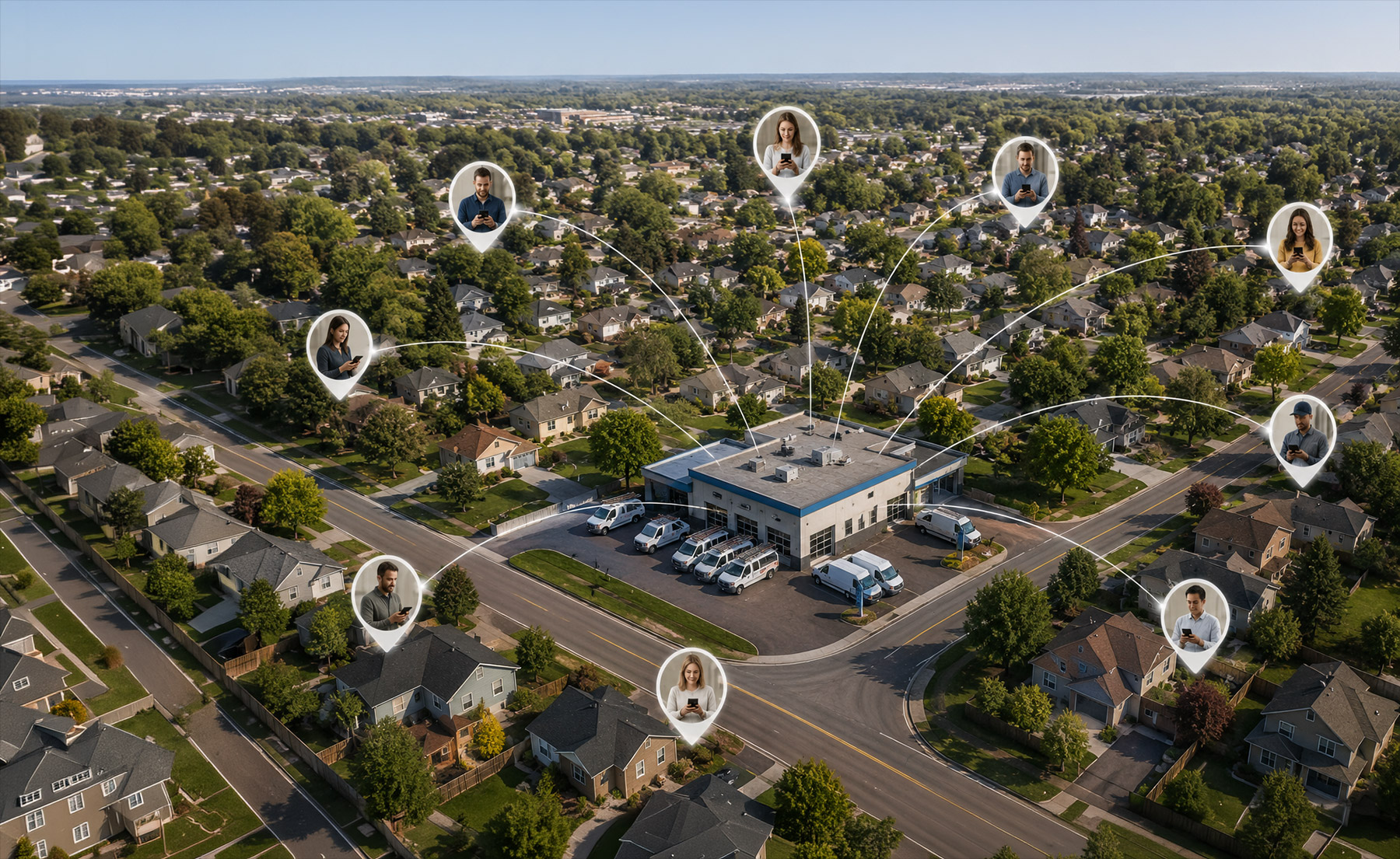
HVAC Local SEO helps your company appear when people search for services in your area.
This includes the local map results, your Google Business Profile, location-based website pages, service pages, reviews, and local business information across the web.
Local SEO is important because many HVAC searches include geographic intent, even when the city name is not typed.
Google uses the searcher’s location to identify nearby companies.
Optimize Your Google Business Profile
Your Google Business Profile is one of your most valuable local marketing assets.
Make sure the following information is accurate:
- Business name
- Primary category
- Secondary categories
- Address or service area
- Phone number
- Website
- Business hours
- Emergency or extended hours
- Services
- Photos
- Appointment links
Do not add unnecessary keywords to your business name unless they are part of your legal, real-world company name. This can create profile problems and make the listing look less credible.
Add current photos regularly. Show technicians, branded vehicles, completed installations, equipment, your office, and your team.
Real photos tend to build more trust than generic stock images of smiling technicians who do not work for your company.
Build Strong Service Pages
Your website should have a dedicated page for each major service.
A single “HVAC Services” page rarely provides enough detail to compete for multiple searches.
Separate pages may include:
- Air conditioning repair
- AC replacement
- Furnace repair
- Furnace installation
- Heat pump repair
- Heat pump installation
- HVAC maintenance
- Indoor air quality
- Duct repair
- Commercial HVAC service
Each page should explain the service, common symptoms, your process, expected next steps, service areas, and reasons customers choose your company.
Avoid creating pages that simply swap the city name while keeping all other text identical.
Useful local pages should include real details about the area, service coverage, common property types, regional climate concerns, and nearby communities.
Develop a Review Process
Reviews are not just a reputation tool. They also affect local visibility and conversion.
The best time to request a review is shortly after a successful service interaction.
For a repair call, that may be after the technician restores comfort and explains the work.
For an installation, it may be after the final walkthrough, thermostat setup, and cleanup.
Build the request into your workflow.
A simple process might include:
- Technician confirms the customer is satisfied.
- Office sends a text or email with a direct review link.
- Customer receives one polite reminder several days later.
- Staff responds to the review.
Do not pressure customers or offer rewards in exchange for positive reviews.
Ask for honest feedback and make the process easy.
Responses should sound human. Avoid pasting the same two-sentence reply under every review.
Turn Existing Customers Into a Growth Channel
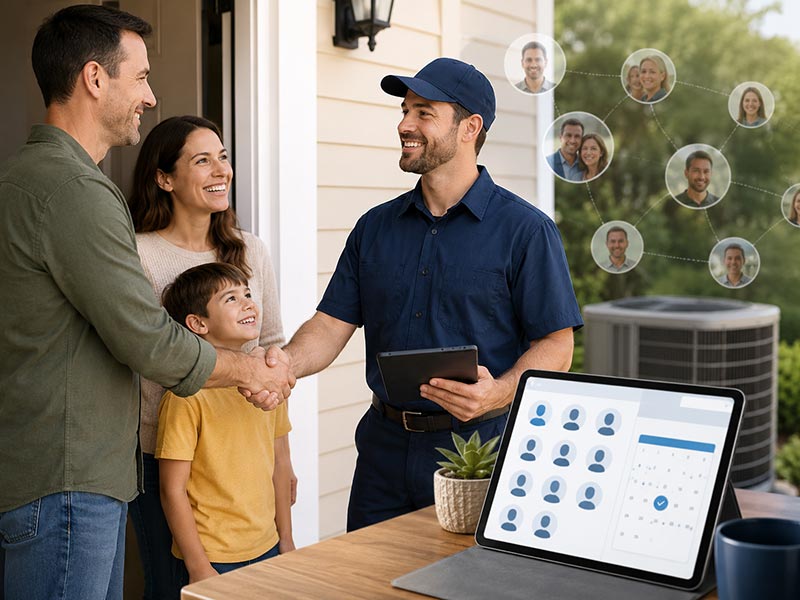
The customer list you already have may be more valuable than your next cold advertising list.
Past customers know your company. They have already trusted you in their home. Marketing to them usually costs less than acquiring a completely new customer.
Useful customer campaigns include:
- Seasonal maintenance reminders
- Maintenance plan renewals
- Filter replacement reminders
- Equipment warranty reminders
- Indoor air quality education
- Replacement planning for older systems
- Referral campaigns
- Lapsed customer reactivation
- Post-installation check-ins
Segment the list whenever possible.
A customer with a system installed two years ago should receive different messaging than someone whose 14-year-old unit has needed three repairs.
Your service records can help identify valuable opportunities.
For example, you may pull a list of customers with systems over 12 years old who spent more than $1,000 on repairs during the past 24 months. That group may be a strong audience for a replacement consultation campaign.
This type of targeted outreach is more useful than sending the same discount email to everyone in your database.
Make Maintenance Agreements Part of the Marketing Strategy
Maintenance agreements can stabilize revenue, improve customer retention, and create future replacement opportunities.
They also help your company maintain contact with customers between emergencies.
The offer should be easy to understand.
Explain:
- How many visits are included
- What each visit covers
- Whether members receive priority scheduling
- Whether repair discounts are included
- Whether after-hours fees are reduced
- How renewal works
- What happens if equipment needs replacement
Technicians play an important role in enrollment.
They should not use a high-pressure sales script. They should explain the practical value based on the customer’s system and service history.
For example:
“Your system is running properly now, but the outdoor coil is collecting debris and the capacitor is beginning to test near the lower end of its acceptable range. A maintenance plan would allow us to check those items before the peak cooling season.”
That explanation is specific, helpful, and connected to the customer’s equipment.
Improve Call Handling Before Increasing the Budget
Marketing cannot fix a phone process that loses leads.
During peak season, office teams may be handling multiple calls while technicians are sending updates, customers are asking about arrival times, and emergency requests are piling up.
Review how calls are handled.
Important questions include:
- How many calls go unanswered?
- How long do callers stay on hold?
- Are missed calls returned within five minutes or five hours?
- Does the office ask how the customer found you?
- Are financing questions handled confidently?
- Can the team explain diagnostic fees?
- Are replacement opportunities identified?
- Are after-hours calls routed correctly?
Listen to recorded calls when legally permitted. You may discover that a campaign is generating good leads, but callers are leaving because they cannot get a clear appointment time.
A missed call during a heat wave is rarely patient. The homeowner usually calls the next company.
Track Leads From the First Call to the Final Sale
Marketing reports should connect leads to revenue.
Website traffic, impressions, clicks, and rankings are useful, but they do not tell you whether the campaign generated profitable work.
Track:
- Lead source
- Service requested
- City or ZIP code
- New or existing customer
- Appointment scheduled
- Appointment completed
- Estimate provided
- Job sold
- Revenue
- Marketing cost
- Cancellation reason
- Lost job reason
Call tracking numbers can help identify which campaigns generated phone calls. Form tracking can show which pages or ads produced online requests.
Your office staff also needs a simple process for confirming lead sources.
“Internet” is not specific enough.
Was it Google Ads, Google Maps, an organic search result, Facebook, a direct mail postcard, an email, or a referral?
The more accurate the data, the easier it becomes to improve your marketing.
Review Marketing and Operations Together
Marketing performance cannot be evaluated in isolation.
A drop in booked appointments may be caused by weak ads. It may also be caused by limited technician availability, slow call response, poor geographic targeting, or a pricing issue.
Hold regular reviews that include marketing and operational information.
Look at:
- Lead volume by source
- Booking rate
- Average ticket
- Replacement estimates
- Estimate close rate
- Cost per lead
- Cost per booked call
- Cost per sale
- Revenue by campaign
- Technician capacity
- Schedule availability
- Service area profitability
- Customer review trends
This creates a more honest picture.
Imagine that a replacement campaign generates 20 estimate requests. Twelve appointments are completed, but only two jobs are sold.
The problem may not be lead generation. The company may need to review its sales presentation, estimate follow-up, financing options, pricing, or appointment qualification process.
Marketing data tells you where to look. It does not always tell you the entire story.
Balance Immediate Leads With Long-Term Brand Visibility
HVAC companies often invest heavily in lead generation during busy months and disappear during slower periods.
That can create an expensive cycle.
When demand returns, the company must rebuild visibility while competing against contractors that maintained a steady presence.
A balanced strategy includes both demand capture and demand creation.
Demand capture reaches homeowners already searching for help. Paid search and local SEO are strong examples.
Demand creation builds awareness before the homeowner begins searching. Direct mail, community sponsorships, social content, email, branded vehicles, and neighborhood campaigns can support this goal.
The strongest HVAC brands use both.
A homeowner may receive a tune-up postcard in April, see one of your trucks in the neighborhood in May, notice your company sponsoring a local youth team in June, and search your name when the AC fails in July.
No single impression receives full credit, but the combined visibility creates trust.

Common HVAC Marketing Mistakes
Turning Campaigns On Too Late
Waiting for extreme weather means entering the market when advertising costs and competition are already high.
Sending Every Visitor to the Homepage
Service-specific traffic usually performs better when sent to a relevant landing page.
Advertising Outside Practical Service Areas
A larger radius may generate more leads but lower profitability and disrupt scheduling.
Ignoring Existing Customers
Past customers are often the easiest audience to reach for maintenance, referrals, and replacements.
Measuring Leads Without Measuring Sales
A low-cost lead is not valuable if it never becomes a booked job.
Using the Same Offer All Year
A tune-up message that works in April may have little impact during a July heat wave.
Failing to Answer the Phone
Every marketing channel becomes more expensive when qualified calls are missed.
Depending on One Lead Source
Relying entirely on paid ads, lead aggregators, or referrals leaves the business vulnerable when costs or market conditions change.

How TurnHeads Marketing Approaches HVAC Marketing
At TurnHeads Marketing, we look at the full local customer journey.
We do not treat direct mail, digital campaigns, and local SEO as unrelated services. They should support one another.
Our process begins with the market.
We review the services you want to grow, the areas you can serve efficiently, your seasonal capacity, your strongest customer types, and the systems you already use to handle leads.
From there, we can build campaigns that match your operation.
That may include an HVAC Direct Mail Service focused on older owner-occupied homes, an HVAC Digital Marketing campaign built around high-intent repair and replacement searches, and an HVAC Local SEO plan designed to improve visibility across the cities and neighborhoods you serve.
We also look at what happens after the lead arrives.
- Are calls answered quickly?
- Are form submissions followed up with?
- Can your team identify replacement opportunities?
- Are campaign sources recorded accurately?
- Does the schedule have enough capacity to support the promotion?
Marketing works best when it is connected to real business conditions.

Build a Marketing System That Can Grow With You
The goal of HVAC marketing is not to generate random bursts of activity.
It is to create a dependable system that helps your company attract the right customers, in the right locations, for the right services.
That system should include several channels.
- Direct mail helps you reach targeted households and build awareness.
- Digital advertising captures urgent demand.
- Local SEO strengthens long-term visibility.
- Email and customer outreach support retention.
- Reviews build trust.
- Call tracking and sales data show what is actually working.
No single tactic carries the entire strategy.
When these parts work together, your company becomes easier to find, easier to trust, and easier to choose.
That is what turns marketing from an expense into a growth tool.
Frequently Asked Questions
Publishing exact pricing can be difficult because equipment size, efficiency, ductwork, electrical requirements, and installation conditions vary. Many companies provide realistic starting ranges while encouraging customers to schedule an in-home assessment.
Yes. Property managers can provide recurring repair, maintenance, and replacement work, but they usually need fast communication, dependable documentation, and clear approval procedures.
Shift the message toward preventive maintenance, indoor air quality, energy efficiency, ductwork, commercial service, and early replacement planning rather than relying only on emergency demand.
With the customer’s permission, photos can document equipment conditions, support estimates, improve communication, and provide useful material for educational marketing.
They can, especially when the sponsorship is supported by signage, social media, direct mail, and consistent local involvement. A logo alone may create awareness, but repeated community visibility is more effective.
Core service pages should be reviewed at least once or twice a year, while hours, offers, staff information, financing details, service areas, and seasonal messaging should be updated whenever they change.
They can help fill schedule gaps, but lead quality, shared-lead competition, fees, and close rates should be tracked carefully. They should not replace development of your own customer base and brand visibility.
Financing can reduce hesitation for major replacements, especially when the advertisement clearly explains that approval and terms may vary. Your office and sales team should be prepared to explain the application process.
Use a structured follow-up process that may include a phone call, text message, email, and later reminder. Replacement leads often require more follow-up than emergency repair calls.
Start with existing customers, especially households with allergies, pets, humidity concerns, recurring dust issues, or recent ductwork problems. Education usually works better than using fear-based claims.